Wheeling sits on heavy clay till, the same stuff the glaciers left behind across most of Cook and Lake County. Clay holds water like a sponge through a wet spring and shrinks hard in a dry August. That movement is the first thing that should shape how a deck gets built here, long before anyone talks about railing style or composite color.
What the ground is actually doing under a deck
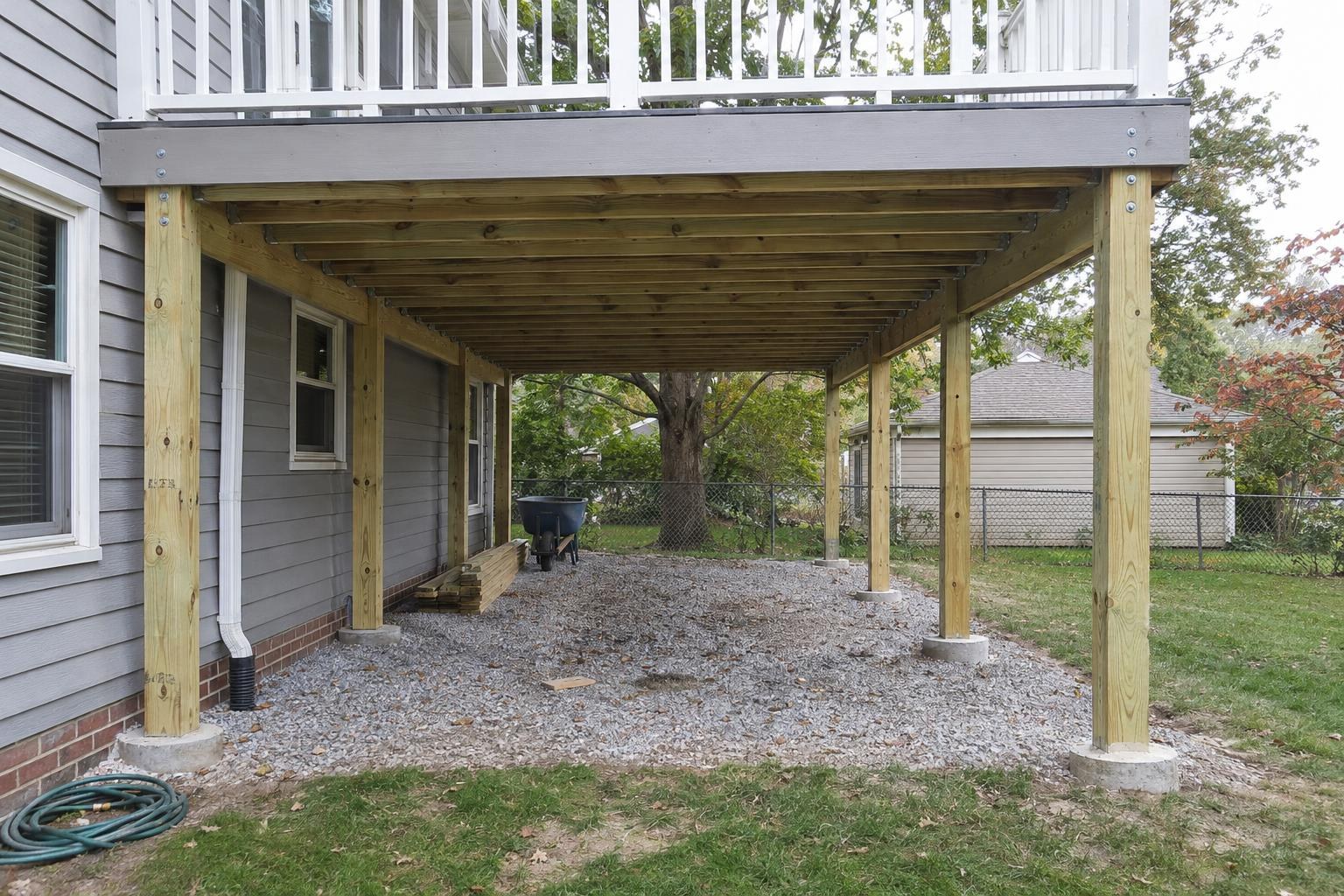
Footings in this area have to go below the frost line, which in Cook County is commonly figured at 42 inches. A footing that stops short of that depth will heave when the ground freezes and thaws, and it won't heave evenly. One corner of the deck lifts a half inch more than the other, and the whole frame racks out of square, the railing posts tilt, and the boards cup at the seams a season or two later. A builder who tells you surface deck blocks are fine for Wheeling is telling you something false, not something convenient.
Ask what footing depth they're planning and ask them to show you on the permit drawing, not just tell you over coffee. A poured concrete pier sized to the post load, set below 42 inches, is standard here. Sonotubes work fine when they're set right. The depth is what matters, not the brand of tube.
Permits aren't a formality in Wheeling
Most raised decks attached to a house require a building permit through the village, and that permit triggers at least two inspections: one after the footings are dug and before concrete goes in, and one after framing, before the decking boards cover up the joists and hardware. Some towns around here also check railing height and baluster spacing at a final inspection.
If a contractor offers to skip the permit to save you money, that's not a discount, that's a decision being made for you without your name on it. An unpermitted deck can slow down a home sale later, since a buyer's inspector or the title company can ask for records that don't exist. Some newer subdivisions around Wheeling, especially near the Buffalo Grove and Arlington Heights borders, also carry HOA rules on deck size, material, and setback from the property line, on top of whatever the village code requires. A builder working this area regularly checks both before drawing up plans, not after the footings are in.
The ledger board is where most failures start
If the deck attaches to the house, the ledger board bolted to the rim joist is doing most of the structural work, and it's also the part most often done wrong. Older decks around here, especially ones built in the 70s and 80s on the ranch and split-level homes that make up a lot of Wheeling's housing stock, were frequently hung with lag screws into the rim joist with no flashing behind them. Water works its way behind the ledger, the rim joist rots from the inside out, and eventually the whole deck pulls away from the house. This is still the single most common cause of serious deck collapse, and it rarely shows warning signs until the board is already soft.
Current practice is through-bolts or structural lag screws rated for the load, with flashing that carries water away from the house framing instead of behind it. If you're having an older deck rebuilt or resurfaced, ask specifically what's happening at the ledger. A builder who glosses over that question, or treats it as unimportant, isn't someone to hire for anything structural.
Drainage, grading, and what a heavy rain does to a lot here
A lot of Wheeling's older lots grade gently toward the back property line, and a deck sitting low to grade can trap water against the foundation if nobody thinks about it. Gaps between boards, usually 1/8 to 3/16 inch, let rain pass through instead of pooling on the surface, but that water still has to go somewhere once it hits the ground underneath. A deck built over bare dirt holds moisture longer than one built with a few inches of gravel or a sloped grade carrying water away from the house. On a screened porch and deck combo, this matters even more, since roof runoff now gets added to the mix, and ice damming off that roof section in a hard January can send meltwater right down into framing that wasn't flashed for it.
Material choices that actually hold up to Chicago winters
Pressure-treated pine is still the cheapest frame material and it's fine structurally, but it has to be sealed within the first year and resealed every two to three years after that, especially on horizontal surfaces holding snow and direct sun. Cedar looks better longer but it's softer and shows wear faster under salt and ice melt tracked up from the yard.
Composite decking handles the freeze-thaw cycle Wheeling gets roughly four to five months a year better than it used to, but not all composite performs the same. Capped composite sheds water and resists the chalking that uncapped boards pick up after a few Illinois summers of UV and humidity. Ask which brand and which generation of product a builder is quoting. Composite from ten years ago behaves differently than what's sold today.
What to ask, and what should make you walk
- Ask for proof of insurance and actually look at it, not just hear about it.
- Ask who pulls the permit. It should be the contractor, under their own name, not you filing as an owner-builder on a job you didn't design.
- Ask for the footing depth and the joist span table being used for your deck size. A builder who does this work regularly has that answer memorized, not guessed.
- Walk away from a quote given without a site visit. Soil, slope, and the house's existing framing all change what the job actually requires, and nobody prices that honestly from a phone call.
- Walk away from anyone asking for full payment up front. A deposit for material is normal. The balance follows the work, it doesn't come before it.
- Be cautious of a bid that's dramatically lower than two others for the same footprint and the same material. Somewhere in that price, something is getting skipped, usually footing depth or ledger flashing, the two things you can't see once the boards go down.
A deck is one of the few home improvements where the part that matters most ends up buried under the part you actually look at. A good builder spends the first real conversation with you on footings, span, and attachment, not railing catalogs. If you want that conversation before you spend anything, that's the kind of work we do at Fortwood Deck Builders.